Jenniffer Omaitz – Kent, Ohio

Standard

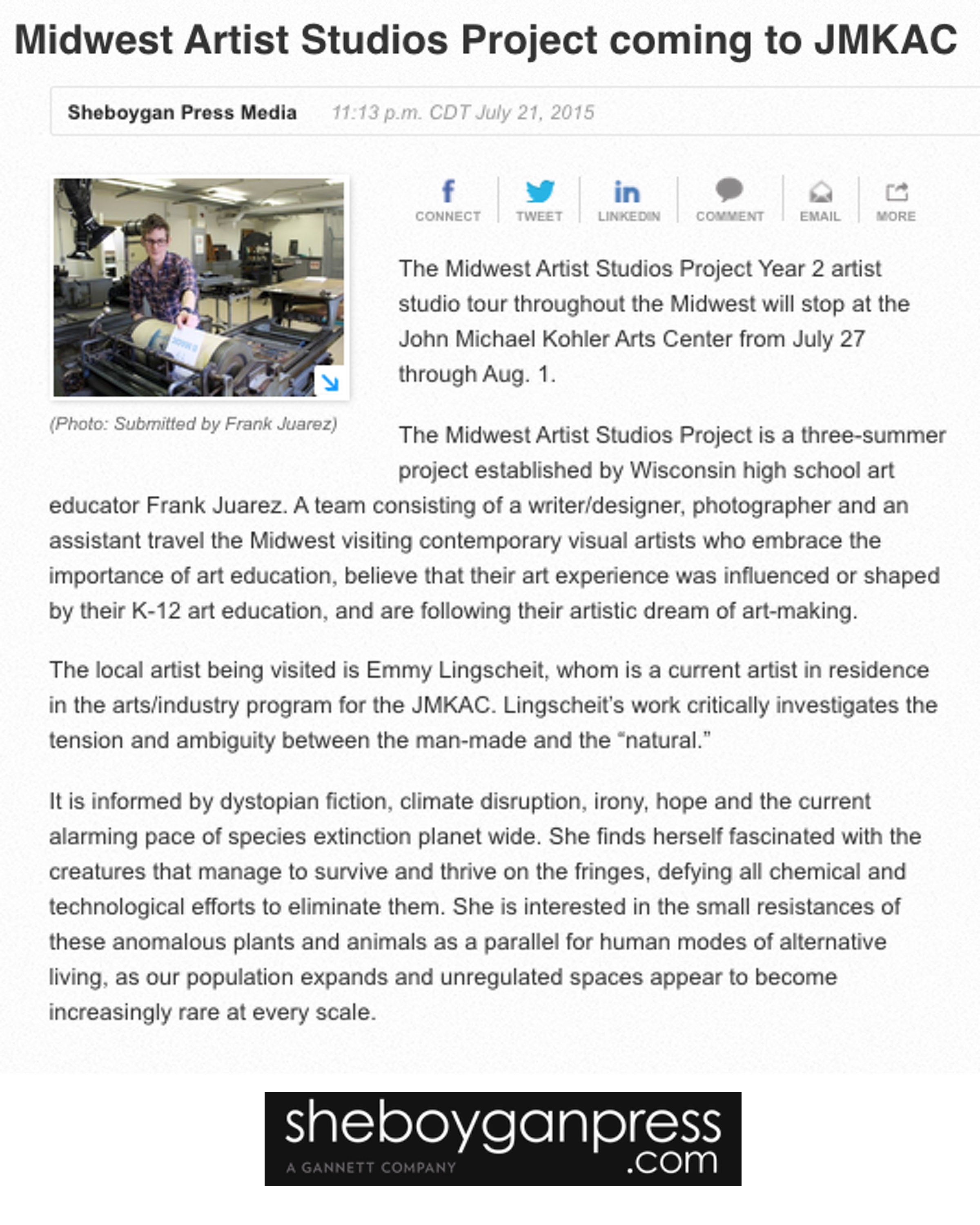
I am extremely excited to be heading into Year 2 of the 3 year project, the Midwest Artist Studios™ (MAS) Project. I will be traveling from July 26 through August 1, 2015 to the following artists/cities/states – Mellissa Redman, Grand Rapids, Michigan; Kate Robertson, Ann Arbor, Michigan; Jenniffer Omaitz, Kent, Ohio; Ellie Honl, Bloomington, Indiana; Jessica Anderson, Jacksonville, Illinois; and Jason Ackman, Rushville, Illinois. In mid-August I will be visiting the John Michael Kohler Arts Center’s Arts/Industry to document Emmy Lingscheit, who is one of our featured 2015 MAS artists and a current artist in resident. In late September, I will finish our documentation/research by visiting Krista Svalbonas, Chicago, Illinois and Emmy Lingscheit, Urbana, Illinois. 

The artists selected were based on their responses to an online survey focusing on Art Education, body of work, and a Skype interview. 

Throughout our visits I will be introducing you to 8 amazing and talented artists from the Midwest working in printmaking to painting, sculpture to mixed media and collage to installation art.

Click here to read a collaborative reflection from this past school year’s MAS Project. 

Join me on this MAS adventure via facebook.com/midwestartiststudios or subscribe to the blog, midwestartiststudios.com

– Frank Juarez

________________________________________________________________________

Here is one of the questions asked on our survey and the artist’s response.

Why is Art Education today?

Art allows young students and students in general to be versatile in multifaceted and have an understanding for cultural experiences. It incorporates cognitive skills with hands-on applications. The way art is taught now occurs in both 2-D and 3-D and virtual environments. This range of experiences along with cultural connections is imperative for young students high school and college age students to become more sensitive and responsive to social and environmental shifts.


Jenniffer Omaitz

Web: www.omaitz.com

Our urban and geographic environment is in a constant state of transformation. My work explores states of change between order and chaos that relate to this experience of environmental shift. Painting and Installation Art are modes of communicating the sensitivity to environmental factors; these practices provide me with a cadence and context through which to communicate utopian elegance, or dystopian plight. Installation explores this order/chaos in theory by invoking parts of abstraction, architecture, landscape, natural disaster, and a tactile response image making. Paintings are a meditation on movement, permutation, gesture, boundary, space and color.

In 2014, I started a series of work titled, Solid Movement. Solid Movement is an investigation into gesture and its ability to encapsulate time and psyche, fuse internal and external, and record conceptual state changes in solidified form. This series struggles to define beauty, exploring abstraction as incident and artifact of the process in which paint is applied. There is a constant struggle between surface and ground; between paint and the boundaries within the painting. This series of work attempts to unify my sculptural endeavors with my interests in painting.

Over the past six years I have explored site-specific installation. The installations built encompass three-dimensional landscapes frozen in the midst of a chaotic event. This “event” is reminiscent of a landscape that has been caught in a fictitious disaster. By incorporating drawing and painting with objects and found materials, this ignites play between the structure of the gallery and the theatrics of the painterly gesture and their united associations. This sense of theater is a formal extension of the shadows cast by gallery lights, the configuration of the wall, ceiling, and the intrinsic architectural nature of the given space.

Overall, my work explores space; both physical and psychological space. This refers to “Space” as it is applied to a two dimensional surface, or a three dimensional location.

Bio

Jenniffer Omaitz (1979, Cleveland, OH) lives in Kent, OH and works in Kent and Cleveland. She holds an MFA in painting from Kent State University and a BFA in painting from the Cleveland Institute of Art. Solo exhibitions of her work have been held at The Sculpture Center, Cleveland; Sandy Carson Gallery, Denver; and Kent State University, and the Museum of Contemporary Art, Cleveland. Her work was featured at the 2010 Biennial of the Americas in Denver. Omaitz is a part-time faculty member at Kent State University, and the University of Akron. She is represented by 1point618 Gallery in Cleveland.


All images copyright of the artist and used with their permission. 


Jessica Anderson – Jacksonville, Illinois

Standard

I am extremely excited to be heading into Year 2 of the 3 year project, the Midwest Artist Studios™ (MAS) Project. I will be traveling from July 26 through August 1, 2015 to the following artists/cities/states – Mellissa Redman, Grand Rapids, Michigan; Kate Robertson, Ann Arbor, Michigan; Jenniffer Omaitz, Kent, Ohio; Ellie Honl, Bloomington, Indiana; Jessica Anderson, Jacksonville, Illinois; and Jason Ackman, Rushville, Illinois. In mid-August I will be visiting the John Michael Kohler Arts Center’s Arts/Industry to document Emmy Lingscheit, who is one of our featured 2015 MAS artists and a current artist in resident. In late September, I will finish our documentation/research by visiting Krista Svalbonas, Chicago, Illinois and Emmy Lingscheit, Urbana, Illinois. 

The artists selected were based on their responses to an online survey focusing on Art Education, body of work, and a Skype interview. 

Throughout our visits I will be introducing you to 8 amazing and talented artists from the Midwest working in printmaking to painting, sculpture to mixed media and collage to installation art.

Click here to read a collaborative reflection from this past school year’s MAS Project. 

Join me on this MAS adventure via facebook.com/midwestartiststudios or subscribe to the blog, midwestartiststudios.com

– Frank Juarez

________________________________________________________________________

Here are two of the questions asked on our survey and the artist’s response.

Please share one positive Art Education experience that you had in middle school, high school or college.

While it is hard to select just one, all of my important moments came when an instructor granted me permission to follow my instincts. In college, I was pursuing a triple major in Painting, Women’s Studies, and Religious Studies. I found connections in all of these academic areas and was thriving with my personal research. But in a quick period of time, my sketchbook began to fill with ideas for sculptures and dimensional forms. I found myself unable to paint and felt this surge and urge to sculpt. This was tough on me, because I did not know anything about sculpture and held such a strong identity to painting.

After meeting with the sculpture professor at my school (now deceased, David Newton), he encouraged me to work independently with him and gave me the resources to begin sculpting. This meeting changed my life. Every professional and artistic accomplishment I have made since this meeting has roots in this initial discussion. David Newton, as an instructor, mentor, and artist, provided me with an academic framework to explore my own inner voice.

This is so important from an art educational standpoint, because the art classroom is a space for permission to thrive. It is a space to nurture empowered decision-making and self accountability. David Newton showed me that I can use the tools and theories that I had learned in all of my art classes and can apply them to the visions that are waiting within me.

Why is Art Education today?

Art education is absolutely essential. It is essential for students who are interested in a future in art and it is also essential for students who are not. While Art Education fosters art-making practices, it also provides students with tools and experiences that are applicable across academic and professional fields.

In the Art classroom, students learn to take risks. Students learn to strategize. It is a hands-on environment for materializing problem-solving practices and becoming familiar with their own relationship to success and failure. (I do not mean failure of my Class, but rather, when we try something and it does not work how we intended. “Failure” is relative and it is a moment that I celebrate with the student because it is a place of creative improvisation and discovery).

We learn to be human in an art classroom – we learn to be resilient, we learn to be self-motivated, and we learn the power of our own inner expression. I think that Art Education is THE most important class in a curriculum because it teaches students the power of their own potential, regardless of their “artistic” ability.

Jessica Anderson

Web: www.jessicabrookeanderson.com

Part research, part design, part invention – Jessica Anderson’s work navigates the boundary between mind and body through a recontextualized lens of science, medicine, and biologic phenomena. Reminiscent of laboratory investigations, her invented scenarios answer questions with questions and provoke participatory explorations of the individual self.

Taking the position as neither a skeptic nor a promoter, her research examines the role of holistic healing practices in contemporary culture. She is interested in individual relationships within these mechanisms of health and provide viewers with opportunities to test their own boundaries of belief. Reframing practices such as a detoxifying footbath, a chi activation machine, and phenomenological exercises, her recontextualization of existing treatments heightens the tension of purpose, and provides viewers with neutral environments of investigation.

Merging factual information with reinvented application allows her to expand the dialogue of cognitive occurrences. For instance, EMDR therapy asks patients to lean their head to the left to access thoughts and to lean their head to the right to access feelings and emotions. Redirecting this information, she then asks: Is there a discernible difference between these two cerebral directions when drawing a line?

It is a question that can only be answered through experience, observation, and communally applied analytics.

In Anderson’s work, invitations for experience occur through demonstrative videos, interactive objects/devices, evocative statements of research, and performative exercises. Together, each of these installation elements create a multi-dimensional environment of investigative viewing, biologic questioning, and experiential answering. By repositioning scientifically grounded phenomena into the context of a gallery, information begins to transcend ratiocination and calls upon a physical conversation between mind, body, and personal experience.

Bio

Jessica Anderson currently serves as an Assistant Professor of Art at Illinois College in Jacksonville, IL. She received her BA in Studio Art from Guilford College in 2007 and her MFA in Sculpture from the University of Tennessee in 2013, where she served as a Graduate Teaching Associate and Director of the University exhibition space, Gallery 1010.

In her work, invitations for experience occur through demonstrative videos, interactive objects/devices, evocative statements of research, and performative exercises. Jessica has exhibited both nationally and internationally including an interactive outdoor installation on the border of Finland and Sweden in association with the Magneetti Foundation. Other exhibition sites include London, England, Toronto, Canada, and throughout the United States. Jessica has been an Artist-in-Residence at Spark Box Studio, in Ontario, Canada and a participant in the “Silence. Awareness. Existence.” residency at the Arteles Center in Haukijärvi, Finland.

Gallery

All images copyright of the artist and used with their permission. 

Kate Robertson – Ann Arbor, Michigan

Standard

I am extremely excited to be heading into Year 2 of the 3 year project, the Midwest Artist Studios™ (MAS) Project. I will be traveling from July 26 through August 1, 2015 to the following artists/cities/states – Mellissa Redman, Grand Rapids, Michigan; Kate Robertson, Ann Arbor, Michigan; Jenniffer Omaitz, Kent, Ohio; Ellie Honl, Bloomington, Indiana; Jessica Anderson, Jacksonville, Illinois; and Jason Ackman, Rushville, Illinois. In mid-August I will be visiting the John Michael Kohler Arts Center’s Arts/Industry to document Emmy Lingscheit, who is one of our featured 2015 MAS artists and a current artist in resident. In late September, I will finish our documentation/research by visiting Krista Svalbonas, Chicago, Illinois and Emmy Lingscheit, Urbana, Illinois. 

The artists selected were based on their responses to an online survey focusing on Art Education, body of work, and a Skype interview. 

Throughout our visits I will be introducing you to 8 amazing and talented artists from the Midwest working in printmaking to painting, sculpture to mixed media and collage to installation art.

Click here to read a collaborative reflection from this past school year’s MAS Project. 

Join me on this MAS adventure via facebook.com/midwestartiststudios or subscribe to the blog, midwestartiststudios.com

– Frank Juarez

________________________________________________________________________

Here are two of the questions asked on our survey and the artist’s response.

Please share one positive Art Education experience that you had in middle school, high school or college.

 I think my artistic path has been aided in countless ways by instructors and individuals with a desire to share their excitement and knowledge on how to be a maker. Without these wonderful mentors at all stages of my life I would not have found such a fulfilling career in the arts. I hope to be a leader in passing that energy on to others.

Why is Art Education today?

As a part of a non-profit art center I continual see not only the need but the desire within my community for quality Art Education. As these programs continue to be cut from schools the need and desire for them does not go away. We are also collaborating and working to provide a place where individuals of all ages can have the ability to incorporate technology into their art practice.

Kate Robertson

Webwww.k8robertson.com

Kate Robertson creates objects that establish an intimate viewing experience and question the ways we interpret incomplete information. By exploring the dichotomy between interior and exterior spaces her  intention is for the viewer to be engaged in a space separate from their body. The inability to simultaneously see the exterior and interior allows her to broach notions of fragmentation, cropping and collage. She likes to approach the interior spaces with a sense of exploration and a connection the venue in which they are to be displayed.

Bio

Kate received her BFA from Minnesota State University in Moorhead Minnesota with an emphasis in sculpture as well as a minor in Art History. She is currently the Director of Education at the Ann Arbor Art Center and is preparing for a large contemporary outdoor art exhibition taking place in downtown Ann Arbor this October.

Gallery

All images copyright of the artist and used with their permission. 

Krista Svalbonas – Chicago, Illinois

Standard

I am extremely excited to be heading into Year 2 of the 3 year project, the Midwest Artist Studios™ (MAS) Project. I will be traveling from July 26 through August 1, 2015 to the following artists/cities/states – Mellissa Redman, Grand Rapids, Michigan; Kate Robertson, Ann Arbor, Michigan; Jenniffer Omaitz, Kent, Ohio; Ellie Honl, Bloomington, Indiana; Jessica Anderson, Jacksonville, Illinois; and Jason Ackman, Rushville, Illinois. In mid-August I will be visiting the John Michael Kohler Arts Center’s Arts/Industry to document Emmy Lingscheit, who is one of our featured 2015 MAS artists and a current artist in resident. In late September, I will finish our documentation/research by visiting Krista Svalbonas, Chicago, Illinois and Emmy Lingscheit, Urbana, Illinois. 

The artists selected were based on their responses to an online survey focusing on Art Education, body of work, and a Skype interview. 

Throughout our visits I will be introducing you to 8 amazing and talented artists from the Midwest working in printmaking to painting, sculpture to mixed media and collage to installation art.

Click here to read a collaborative reflection from this past school year’s MAS Project. 

Join me on this MAS adventure via facebook.com/midwestartiststudios or subscribe to the blog, midwestartiststudios.com

– Frank Juarez

________________________________________________________________________

Here are two of the questions asked on our survey and the artist’s response.

Please share one positive Art Education experience that you had in middle school, high school or college.

I have to thank my high school art teachers for being so amazingly supportive of me. After exhausting every art class possible in the school they devised a series of independent studies for me to focus on media and ideas that I wished to explore. Without there continual sponsorship who knows where I would be.

Why is Art Education today?

I read an article the other day that talked about an MFA being the new MBA. So much of today’s world is looking for the creative thinker, someone who can “think outside of the box”. Arts education, as that article adeptly put, is filled with ways to problem solve, think conceptually, flexibility and of course creativity. Without arts education many of our cultural, technological and social advances wouldn’t have happened.

Krista Svalbonas

Web: www.kristasvalbonas.com

head_shotIn the Presence of Memory Statement:

I grew up in an area of Pennsylvania dominated by the steel industry, and have long been interested in industrial architecture as an expression of cultural history.  “In the Presence of Memory” explores the architectural vestiges of a far more ancient industry: agriculture. The disappearing vernacular architecture of barns in rural Pennsylvania reveals their varied European lineages: specific structural elements reflect the building traditions of the home countries of the immigrant families who built them. A typology of these barn structures bears witness to centuries of migration. But what once seemed a stable and permanent destination is now in flux, as the family farm gives way to industrial farming, and farmland is converted to residential or commercial developments. For the past year I have been traveling throughout my home state to document these agricultural structures: abandoned, re-purposed, or – occasionally – still in use.  These photographic images have become the source material for this body of work. Using industrial felt (manufactured in Pennsylvania) as a substrate, I silk-screen images of architectural details of the barns using industrial pigments such as steel, iron and copper. I paint each piece individually using oil and cold wax, and cut into the felt, echoing the empty and thatched spaces of the often-dilapidated structures I have photographed. I “patch” these cut areas with colored sections of serigraph negatives, mimicking the splashes of incongruous color on the weathered surfaces that have been repaired again and again. The colors, forms and shapes of the felt panels all refer to the original structures; even in their abstraction, these paintings document the vanishing rural industrial landscape.

Bio

Krista Svalbonas holds a BFA in photography and design from Syracuse University and an interdisciplinary MFA in photography, sculpture and design from SUNY New Paltz. She has exhibited at the Miller Yezerski Gallery, Massachusetts; Watchung Art Center and George Segal Gallery in New Jersey; Monterey Peninsula Art Gallery in California; Kenise Barnes Fine Art, Matteawan Gallery, The Painting Center, Trestle Gallery, and BWAC in New York; and Tubac Center For The Arts, Arizona. She recently completed large-scale site-specific installations at the ISE Cultural Foundation in New York and Wall Gallery in Oakland, California. She was part of a two-year traveling group exhibition in Latvia, where her work was acquired for the permanent collection of the Cesis Art Museum. She is a recipient of a Cooper Union artist residency as well as a New Arts Program residency and exhibition, and was awarded a Bemis fellowship for 2015. Svalbonas is currently a lecturer in photography at Columbia College.

Gallery


All images copyright of the artist and used with their permission. 

Mellissa Redman – Grand Rapids, Michigan

Standard

I am extremely excited to be heading into Year 2 of the 3 year project, the Midwest Artist Studios™ (MAS) Project. I will be traveling from July 26 through August 1, 2015 to the following artists/cities/states – Mellissa Redman, Grand Rapids, Michigan; Kate Robertson, Ann Arbor, Michigan; Jenniffer Omaitz, Kent, Ohio; Ellie Honl, Bloomington, Indiana; Jessica Anderson, Jacksonville, Illinois; and Jason Ackman, Rushville, Illinois. In mid-August I will be visiting the John Michael Kohler Arts Center’s Arts/Industry to document Emmy Lingscheit, who is one of our featured 2015 MAS artists and a current artist in resident. In late September, I will finish our documentation/research by visiting Krista Svalbonas, Chicago, Illinois and Emmy Lingscheit, Urbana, Illinois. 

The artists selected were based on their responses to an online survey focusing on Art Education, body of work, and a Skype interview. 

Throughout our visits I will be introducing you to 8 amazing and talented artists from the Midwest working in printmaking to painting, sculpture to mixed media and collage to installation art.

Click here to read a collaborative reflection from this past school year’s MAS Project. 

Join me on this MAS adventure via facebook.com/midwestartiststudios or subscribe to the blog, midwestartiststudios.com

– Frank Juarez

________________________________________________________________________

Here are two of the questions asked on our survey and the artist’s response.

Please share one positive Art Education experience that you had in middle school, high school or college.

I interned for the West Michigan Center for Arts and Technology from 2013-14 and during that time I saw young teens who were not particularly interested in being in yet another program, let alone an arts program become truly excited about community projects they were involved in. The defining factor for the success of WMCAT is not the facilities or the glamour of the studios, but the genuine interest of the instructors and the hands on approach they have toward their students. These kids were what the school system would have considered not worth the time, but I found them really charming and attentive once given the right amounts of attention and motivation to see a project to it’s completion.

Why is Art Education today?

Art education impacted my decision to pursue art as a career. I was homeschooled from fifth grade until I entered college, but I attended school through fourth grade. The art classes I was involved in helped me to hold on to my creativity through very difficult family circumstances that would have otherwise extinguished my interest in the arts. Once I was homeschooled, my mother recognized that I was artistically inclined she put me in summer programs which fostered education through the arts.

Mellissa Redman 

Web: mellissajredman.smoothfolio.com

Mellissa_Redman (2)


The precursor to her current body of work was her father’s cancer diagnosis in May of 2011. She took this into her artwork as a way to record her feelings at the time, and it slowly evolved into a series of work on its own. The creative process turned from an escape to a cathartic experience. Coping with life is part of our existence as humans. It is an emotional process, affecting each individual differently. The concept of “masking” the true self is something that is well known by nearly every human being. In many ways, it can be described as an elaborate act, a play of sorts; in others, a survival tactic that maintains order and control. She believes both examples of these methods of coping can have positive outcomes.

The portraits in these pieces are not meant to represent any specific person or people group, rather humanity as a whole. Therefore, the expressions of the faces of these figures are neither threatening nor inviting. They are to be viewed as pensive and introverted; facing the viewer, yet clearly not acknowledging him/her for his or her own thoughts. The patterns she uses throughout the picture plane look may appear to be familiar to a viewer, but only in the way that they simply mimic the human fingerprint or loop/whorl pattern in which human hair grows. In addition to the patterning, she alters the smooth surface of the pieces with resin drips and pouring. Additionally, the patterning represents the complexities within oneself as anxieties multiply and are internalized. When light passes through the translucent screen-printed patterns, the portrait in the layers beneath the resin is interrupted. She begins with washes of watercolor that she builds up to increase color saturation. Over this, she uses colored pencil to flesh out the figure’s skin tone and facial details. The only other part of the body shown in this series is the neck, which she has made uniform in each individual piece to create homogeneity.

Once the portrait is completed, she screen prints a transparent thumbprint pattern directly onto the piece and cover the surface with a coating of clear epoxy resin. More transparent screen-printed patterns are printed in between layers of the resin, before the piece is completed. All of the pieces contain at least three layers of resin to achieve the correct amount of layering. The rest of the body is unimportant to this work as the focus is on the head. Behind the head of the figure is a colored disc. Although in art history, a flat disc behind the head of a figure was regarded as a holy symbol, its additional function is to represent a person’s aura (her reasoning for including it is the latter definition). She has modified the aura to act both as a compositional element to frame the face and head, and also to obscure it. Her goal with this series of work is to make the hidden external, to depict how swallowed fears and anxieties would appear if made tangible and visible. Though it’s well known that there are plenty of destructive, unhealthy, and dangerous coping strategies associated with emotional turmoil, she tends to think that there are an equal amount of positive experiences that can be gathered. It is these experiences that give us growth of character, a will to live. These are the experiences she hopes to convey in her work.

Bio

Mellissa Redman earned her Bachelor’s Degree in Painting and Drawing from the University of Akron. A native of Akron, Ohio, Mellissa volunteered her time or artwork to the local YMCA and YWCA chapters, the University of Akron Ballet Institute, the City of Akron, The Chapel: Akron Campus, and the Akron Children’s Hospital. She now resides in Grand Rapids, Michigan where she recently received a Master’s Degree of Fine Art in Painting at the Kendall College of Art and Design. Though she works with water-based media, her paintings also include drawing, printing and collage.


Gallery

All images copyright of the artist and used with their permission.

Reflection: Views from the Road (2014)

Standard

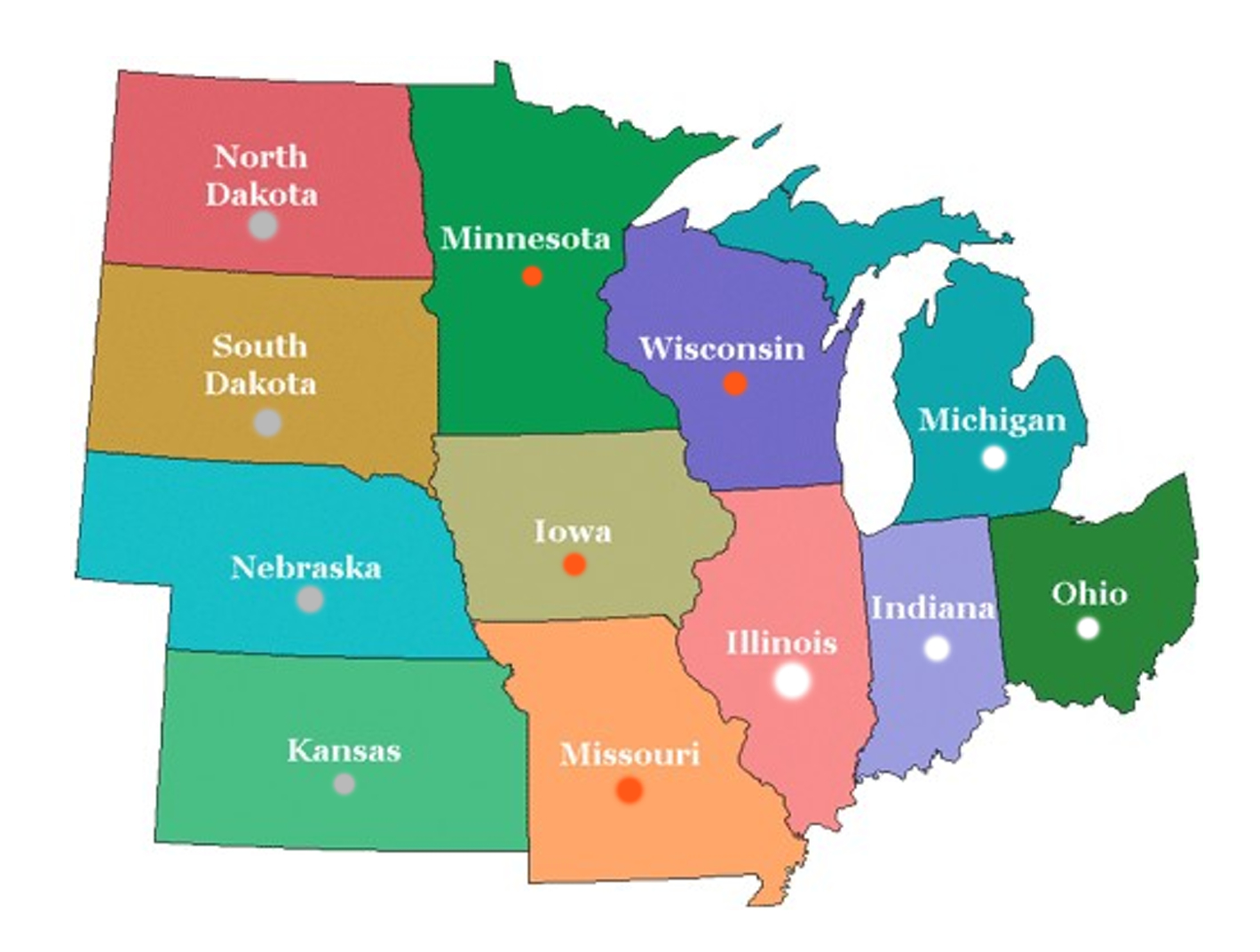
Here is a snapshot from our 2014 Midwest Artist Studios™ (MAS) Project road trip to Minnesota, Iowa, Missouri, and Wisconsin. We are so looking forward to our visit to Michigan, Ohio, Indiana, and Illinois this summer. 

Midwest Map


Ellie Honl – Bloomington, Indiana

Standard

I am extremely excited to be heading into Year 2 of the 3 year project, the Midwest Artist Studios™ (MAS) Project. I will be traveling from July 26 through August 1, 2015 to the following artists/cities/states – Mellissa Redman, Grand Rapids, Michigan; Kate Robertson, Ann Arbor, Michigan; Jenniffer Omaitz, Kent, Ohio; Ellie Honl, Bloomington, Indiana; Jessica Anderson, Jacksonville, Illinois; and Jason Ackman, Rushville, Illinois. In mid-August I will be visiting the John Michael Kohler Arts Center’s Arts/Industry to document Emmy Lingscheit, who is one of our featured 2015 MAS artists and a current artist in resident. In late September, I will finish our documentation/research by visiting Krista Svalbonas, Chicago, Illinois and Emmy Lingscheit, Urbana, Illinois. 

The artists selected were based on their responses to an online survey focusing on Art Education, body of work, and a Skype interview. 

Throughout our visits I will be introducing you to 8 amazing and talented artists from the Midwest working in printmaking to painting, sculpture to mixed media and collage to installation art.

Click here to read a collaborative reflection from this past school year’s MAS Project. 

Join me on this MAS adventure via facebook.com/midwestartiststudios or subscribe to the blog, midwestartiststudios.com

– Frank Juarez

________________________________________________________________________

Here are two of the questions asked on our survey and the artist’s response.

Please share one positive Art Education experience that you had in middle school, high school or college.

It is a challenge to narrow it down to just one! As the daughter of an art educator in Wisconsin, I know that I was privileged to attend public school at a time when art education was a valued and better-funded part of the curriculum. The first art education experience that I can remember had a profound affect on me, because it made me realize that my unique perspective was valued. When I was in kindergarten, my teacher showed us how to make a penguin from cutting and gluing together pieces of construction paper. Having just visited the Chicago zoo where I was mesmerized by the crazy “eyebrows” of rockhopper penguins, I used my leftover pieces of orange paper to create the unique feather plumage. When the teacher saw this addition, she showed my project to the class and I felt an overwhelming sense of pride and validation.

Why is Art Education important today?

Art education is important today, because art teaches students valuable skills that most other subjects don’t. Because art never has one right answer, it empowers students to think for themselves and to consider all possibilities. Art nurtures creative problem solving, curiosity and flexibility, and encourages students to take risks and to embrace ambiguity. Art is a reflection of the culture in which it was created, so studying art has the potential to teach students about history, society, and the makers’ unique point of view. It also has the ability to teach students about themselves and how to express things that cannot be said with words alone. With a fast changing global economy, being able to find creative solutions to new problems will be very important. People that possess creative literacy, will have the skill set to find innovative solutions. Beyond the job market, learning how to create and appreciate visual aesthetics creates a better quality of life and improves society as a whole.

Ellie Honl 

Web: www.elliehonl.com

ellie headEllie’s artwork is about the human desire to find stability in an unsteady present and unpredictable future. Through her artwork, she tries to understand why things are the way they are and strive to find logic in the random. She works intuitively allowing herself to experiment with unpredictable processes to discover new marks and imagery. Many times these initial investigations look chaotic and they provide a problem for her to resolve. She imposes order through geometric forms and color, while making connections through lines, written explanations, and collage elements. These acts of resolution are based on research into theories of geometry, psychology, space, and her own history.  Through a multidisciplinary approach, she creates prints, objects, and moving images that oscillate between rational and irrational, organized and disordered. Printmaking’s unique ability to retain the original image helps her create variables that grow organically and allows her to combine and alter visual elements using a wide variety of media. This layering, warping, and re-presenting information reflects her research in how people make sense of the world around them.

Bio
Ellie Honl is a Visiting Assistant Professor of Printmaking at Indiana University in Bloomington, IN. Combining printmaking, time-based media, and alternative photographic processes, her artwork has been widely exhibited across the United States and is included in many national collections. She has been awarded residencies at Vermont Studio Center and the Kala Art Institute, and has been a visiting artist at numerous universities and art centers. She has previously taught at Arizona State University, the University of Wisconsin-Stevens Point, and the University of Wisconsin-Eau Claire. She received her MA and MFA in Printmaking with a minor in Intermedia from the University of Iowa where she graduated with honors, and received a BA in studio art from St. Olaf College in Northfield, MN. Ellie is from Stevens Point, Wisconsin where her mother is an art teacher in the public school system.

Gallery

Animation Video

All images copyright of the artist and used with their permission. 

Introducing the Midwest Artist Studios 2015 featured artists

Standard

MAS2015_announcementThe Midwest Artist Studios Project is proud to announce its 2015 featured artists. They are Jason Ackman (IL), Jessica Anderson (IL), Ellie Honl (IN), Emmy Lingscheit (IL), Jenniffer Omaitz (OH), Mellissa Redman (MI), Kate Robertson (MI), and Krista Svalbonas. We were impressed with their perspective on art education today and the work that they are producing. The final interview took place via multiple Skype sessions. Although they were given time to make a decision whether or not they would be interested in participating in this project they all said, “Yes!”, immediately. 

The MAS Team will be traveling through the Midwest later this summer. 

We are looking forward to getting to know these artists better as the summer progresses as well as being invited into their studios. 

Some new additions to the MAS Project will be View from the Road by the MAS Team and a special studio visit with Emmy Lingscheit at the John Michael Kohler Arts Center Arts/Industry Program. 

Check out our featured artists’ work by clicking on their names listed above. 

This 2015 MAS Project is supported by a grant from the National Art Education Foundation, Kohler Foundation, Inc., and the Wisconsin Art Education Association.