Tag Archives: literacy
Krista Svalbonas – Chicago, Illinois
StandardI am extremely excited to be heading into Year 2 of the 3 year project, the Midwest Artist Studios™ (MAS) Project. I will be traveling from July 26 through August 1, 2015 to the following artists/cities/states – Mellissa Redman, Grand Rapids, Michigan; Kate Robertson, Ann Arbor, Michigan; Jenniffer Omaitz, Kent, Ohio; Ellie Honl, Bloomington, Indiana; Jessica Anderson, Jacksonville, Illinois; and Jason Ackman, Rushville, Illinois. In mid-August I will be visiting the John Michael Kohler Arts Center’s Arts/Industry to document Emmy Lingscheit, who is one of our featured 2015 MAS artists and a current artist in resident. In late September, I will finish our documentation/research by visiting Krista Svalbonas, Chicago, Illinois and Emmy Lingscheit, Urbana, Illinois.
The artists selected were based on their responses to an online survey focusing on Art Education, body of work, and a Skype interview.
Throughout our visits I will be introducing you to 8 amazing and talented artists from the Midwest working in printmaking to painting, sculpture to mixed media and collage to installation art.
Click here to read a collaborative reflection from this past school year’s MAS Project.
Join me on this MAS adventure via facebook.com/midwestartiststudios or subscribe to the blog, midwestartiststudios.com.
– Frank Juarez
________________________________________________________________________
Here are two of the questions asked on our survey and the artist’s response.
Please share one positive Art Education experience that you had in middle school, high school or college.
I have to thank my high school art teachers for being so amazingly supportive of me. After exhausting every art class possible in the school they devised a series of independent studies for me to focus on media and ideas that I wished to explore. Without there continual sponsorship who knows where I would be.
Why is Art Education today?
I read an article the other day that talked about an MFA being the new MBA. So much of today’s world is looking for the creative thinker, someone who can “think outside of the box”. Arts education, as that article adeptly put, is filled with ways to problem solve, think conceptually, flexibility and of course creativity. Without arts education many of our cultural, technological and social advances wouldn’t have happened.
Krista Svalbonas
 In the Presence of Memory Statement:
I grew up in an area of Pennsylvania dominated by the steel industry, and have long been interested in industrial architecture as an expression of cultural history. “In the Presence of Memory” explores the architectural vestiges of a far more ancient industry: agriculture. The disappearing vernacular architecture of barns in rural Pennsylvania reveals their varied European lineages: specific structural elements reflect the building traditions of the home countries of the immigrant families who built them. A typology of these barn structures bears witness to centuries of migration. But what once seemed a stable and permanent destination is now in flux, as the family farm gives way to industrial farming, and farmland is converted to residential or commercial developments. For the past year I have been traveling throughout my home state to document these agricultural structures: abandoned, re-purposed, or – occasionally – still in use. These photographic images have become the source material for this body of work. Using industrial felt (manufactured in Pennsylvania) as a substrate, I silk-screen images of architectural details of the barns using industrial pigments such as steel, iron and copper. I paint each piece individually using oil and cold wax, and cut into the felt, echoing the empty and thatched spaces of the often-dilapidated structures I have photographed. I “patch” these cut areas with colored sections of serigraph negatives, mimicking the splashes of incongruous color on the weathered surfaces that have been repaired again and again. The colors, forms and shapes of the felt panels all refer to the original structures; even in their abstraction, these paintings document the vanishing rural industrial landscape.
Bio
Krista Svalbonas holds a BFA in photography and design from Syracuse University and an interdisciplinary MFA in photography, sculpture and design from SUNY New Paltz. She has exhibited at the Miller Yezerski Gallery, Massachusetts; Watchung Art Center and George Segal Gallery in New Jersey; Monterey Peninsula Art Gallery in California; Kenise Barnes Fine Art, Matteawan Gallery, The Painting Center, Trestle Gallery, and BWAC in New York; and Tubac Center For The Arts, Arizona. She recently completed large-scale site-specific installations at the ISE Cultural Foundation in New York and Wall Gallery in Oakland, California. She was part of a two-year traveling group exhibition in Latvia, where her work was acquired for the permanent collection of the Cesis Art Museum. She is a recipient of a Cooper Union artist residency as well as a New Arts Program residency and exhibition, and was awarded a Bemis fellowship for 2015. Svalbonas is currently a lecturer in photography at Columbia College.
Gallery

Studio shot

In the Presence of Memory_8

In the Presence of Memory_6

In the Presence of Memory_4

In the Presence of Memory_3

In the Presence of Memory_2
All images copyright of the artist and used with their permission.
Ellie Honl – Bloomington, Indiana
StandardI am extremely excited to be heading into Year 2 of the 3 year project, the Midwest Artist Studios™ (MAS) Project. I will be traveling from July 26 through August 1, 2015 to the following artists/cities/states – Mellissa Redman, Grand Rapids, Michigan; Kate Robertson, Ann Arbor, Michigan; Jenniffer Omaitz, Kent, Ohio; Ellie Honl, Bloomington, Indiana; Jessica Anderson, Jacksonville, Illinois; and Jason Ackman, Rushville, Illinois. In mid-August I will be visiting the John Michael Kohler Arts Center’s Arts/Industry to document Emmy Lingscheit, who is one of our featured 2015 MAS artists and a current artist in resident. In late September, I will finish our documentation/research by visiting Krista Svalbonas, Chicago, Illinois and Emmy Lingscheit, Urbana, Illinois.
The artists selected were based on their responses to an online survey focusing on Art Education, body of work, and a Skype interview.
Throughout our visits I will be introducing you to 8 amazing and talented artists from the Midwest working in printmaking to painting, sculpture to mixed media and collage to installation art.
Click here to read a collaborative reflection from this past school year’s MAS Project.
Join me on this MAS adventure via facebook.com/midwestartiststudios or subscribe to the blog, midwestartiststudios.com.
– Frank Juarez
________________________________________________________________________
Here are two of the questions asked on our survey and the artist’s response.
Please share one positive Art Education experience that you had in middle school, high school or college.
It is a challenge to narrow it down to just one! As the daughter of an art educator in Wisconsin, I know that I was privileged to attend public school at a time when art education was a valued and better-funded part of the curriculum. The first art education experience that I can remember had a profound affect on me, because it made me realize that my unique perspective was valued. When I was in kindergarten, my teacher showed us how to make a penguin from cutting and gluing together pieces of construction paper. Having just visited the Chicago zoo where I was mesmerized by the crazy “eyebrows” of rockhopper penguins, I used my leftover pieces of orange paper to create the unique feather plumage. When the teacher saw this addition, she showed my project to the class and I felt an overwhelming sense of pride and validation.
Why is Art Education important today?
Art education is important today, because art teaches students valuable skills that most other subjects don’t. Because art never has one right answer, it empowers students to think for themselves and to consider all possibilities. Art nurtures creative problem solving, curiosity and flexibility, and encourages students to take risks and to embrace ambiguity. Art is a reflection of the culture in which it was created, so studying art has the potential to teach students about history, society, and the makers’ unique point of view. It also has the ability to teach students about themselves and how to express things that cannot be said with words alone. With a fast changing global economy, being able to find creative solutions to new problems will be very important. People that possess creative literacy, will have the skill set to find innovative solutions. Beyond the job market, learning how to create and appreciate visual aesthetics creates a better quality of life and improves society as a whole.
Ellie Honl
Web: www.elliehonl.com
 Ellie’s artwork is about the human desire to find stability in an unsteady present and unpredictable future. Through her artwork, she tries to understand why things are the way they are and strive to find logic in the random. She works intuitively allowing herself to experiment with unpredictable processes to discover new marks and imagery. Many times these initial investigations look chaotic and they provide a problem for her to resolve. She imposes order through geometric forms and color, while making connections through lines, written explanations, and collage elements. These acts of resolution are based on research into theories of geometry, psychology, space, and her own history. Through a multidisciplinary approach, she creates prints, objects, and moving images that oscillate between rational and irrational, organized and disordered. Printmaking’s unique ability to retain the original image helps her create variables that grow organically and allows her to combine and alter visual elements using a wide variety of media. This layering, warping, and re-presenting information reflects her research in how people make sense of the world around them.
Bio
Ellie Honl is a Visiting Assistant Professor of Printmaking at Indiana University in Bloomington, IN. Combining printmaking, time-based media, and alternative photographic processes, her artwork has been widely exhibited across the United States and is included in many national collections. She has been awarded residencies at Vermont Studio Center and the Kala Art Institute, and has been a visiting artist at numerous universities and art centers. She has previously taught at Arizona State University, the University of Wisconsin-Stevens Point, and the University of Wisconsin-Eau Claire. She received her MA and MFA in Printmaking with a minor in Intermedia from the University of Iowa where she graduated with honors, and received a BA in studio art from St. Olaf College in Northfield, MN. Ellie is from Stevens Point, Wisconsin where her mother is an art teacher in the public school system.
Ellie Honl is a Visiting Assistant Professor of Printmaking at Indiana University in Bloomington, IN. Combining printmaking, time-based media, and alternative photographic processes, her artwork has been widely exhibited across the United States and is included in many national collections. She has been awarded residencies at Vermont Studio Center and the Kala Art Institute, and has been a visiting artist at numerous universities and art centers. She has previously taught at Arizona State University, the University of Wisconsin-Stevens Point, and the University of Wisconsin-Eau Claire. She received her MA and MFA in Printmaking with a minor in Intermedia from the University of Iowa where she graduated with honors, and received a BA in studio art from St. Olaf College in Northfield, MN. Ellie is from Stevens Point, Wisconsin where her mother is an art teacher in the public school system.
Gallery

Work in Progress

Studio at Indiana University

Head_in_the_Sand_screenprint_intaglio_collagraph_collage_sewing

Appearances Can Be Deceiving_screenprint_colored pencil

Coming_Together_screenprint_cyanotype_gouache

Take_Root_screenprint_toned cyanotype_collage_sewing

Outgrowth_toned cyanotype_gouache

Becoming_cyanotype_gouache_colored pencil

Assemble_screenprint_toned cyanotype_sewing
Animation Video
All images copyright of the artist and used with their permission.
Midwest Artist Studios™ Lesson Plans Released January 2015
Standard
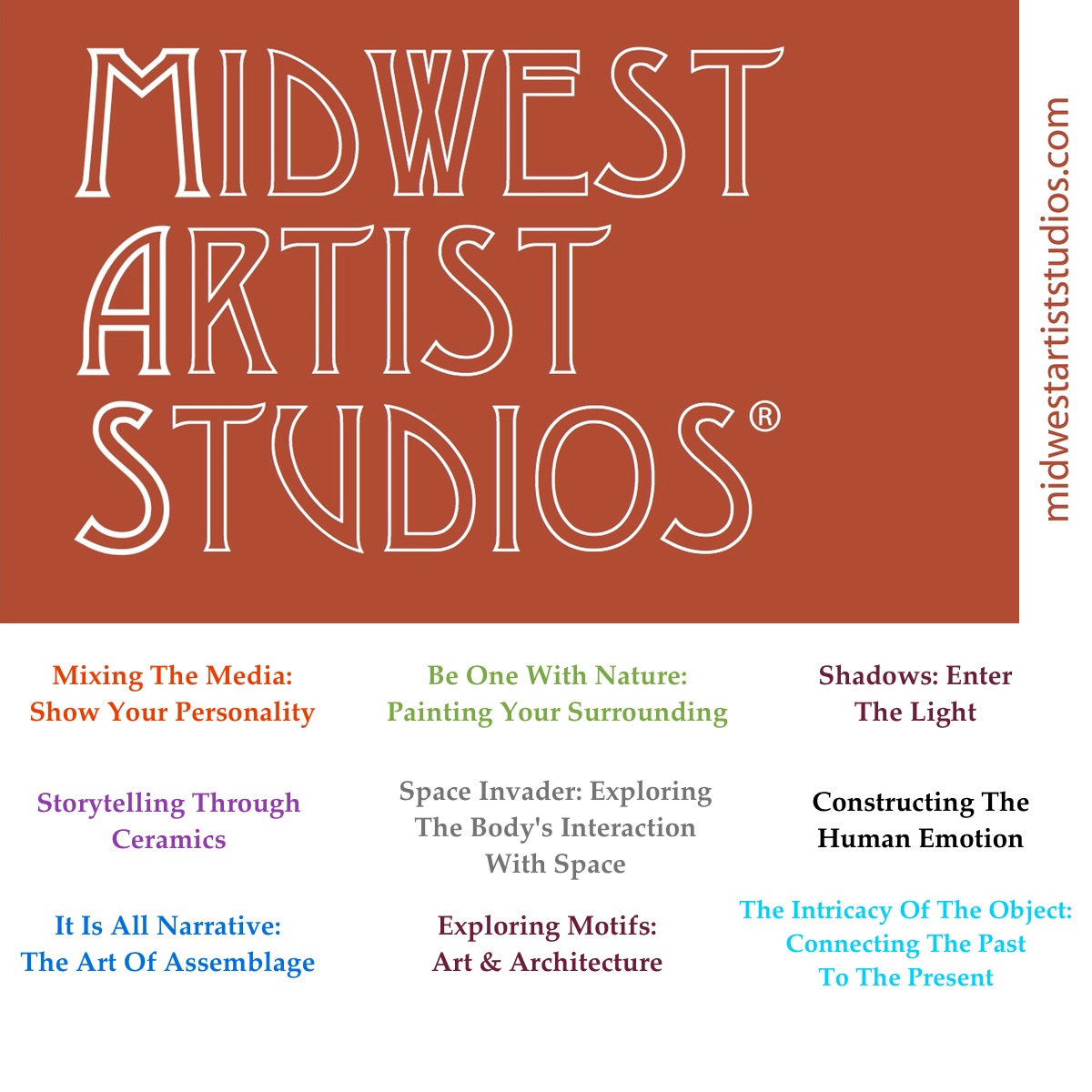
A limited run of our Midwest Artist Studios™ Lesson Plan Workbook will be printed later this month with our release date being early January 2015. These lesson plans come with the National Visual Art Standards, Literacy, differentiated instruction, technology, artist-Skype critiques, and so much more. These lesson plans are inspired by our studio visits with our MAS artists.
We will also be printing a limited run of our Midwest Artist Studios™ Catalog featuring Josh Wilichowski (MN), Vincenzio Donatelle (MN), Jane Ryder (IA), Jamie Bates Slone (MO), Catie Miller (MO), Todd Mrozinski (WI), Paula Schulze (WI), Josie Osborne (WI), and Suzanne Torres (WI).
Below is a snapshot of our 2014 lesson plans.
Midwest Artist Studios ™ Project at the Wisconsin Art Education Association
StandardOn Friday, October 24th, Frank Juarez, founder of the Midwest Artist Studios ™ Project , and two of our featured MAS artists, Todd Mrozinski and Josie Osborne presented at the 2014 Wisconsin Art Education Association Fall Conference at the Bruce Guadalupe Community School in Milwaukee, Wisconsin.
The MAS Project is moving at a steady pace while gaining momentum in the art education field.
The presentation touched upon the following:
- Increasing Literacy within the Art Room.
- Lack of Text-based Resources Addressing Literacy in Art Education.
- Reflecting on Current Teaching Trends.
- Research: a survey which was shared prior to further planning of the MAS Project. One question on the survey addressed, “do you use local artists in your curriculum?”. Here is the overall consensus as to why they do not. 1) Lack of funding to recruit artists in the classroom, 2) grants are too competitive. Same pool of money for all, 3) new to teaching, 4) lack of time, 5) too many things on the teacher’s plate, and 6) do not know any artists in my community or region.
- Purpose of the MAS Project, which focuses on 6-12 art education and curriculum integration. As well as to embrace contemporary art locally and regionally whilst bringing it into the classroom resulting in the design of unit plans concentrating on such as but not limited to: varied art processes, narratives, collaboration, and technology and infuse interaction with the MAS artists into the classroom.
- Implementation of artist-inspired unit plans to be part of a teacher workbook to accompany the Midwest Artist Studio ™ Catalog, which will consist of such as but not limited to: photographs, interviews, artist statements, artist website(s). Unit plans will focus on such as but not limited to: the use of the Elements and Principles of Design, National Visual Arts Standards, Literacy, differentiated instruction and assessments.
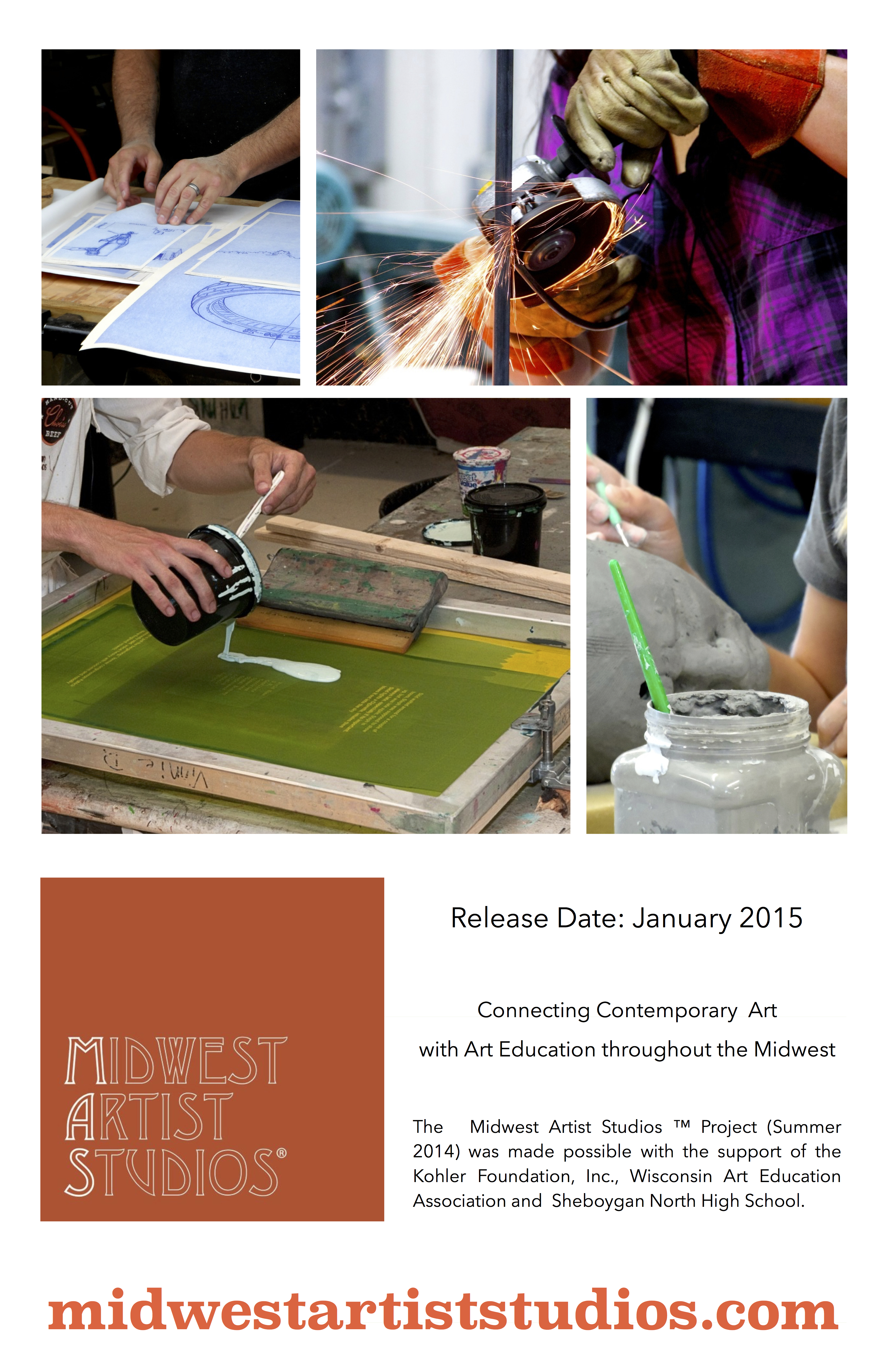
Click here to download this poster
To be put on our MAS Waiting List for our Catalog and/or Workbook contact Frank Juarez at midwestartiststudios(at)gmail.com.
Type in the Subject Box: MAS Waiting List
This project is made possible through the support of the Kohler Foundation, Inc, Wisconsin Art Education Association and Sheboygan North High School.
A note from the founder, Frank Juarez
Standard
Photo by Irma Roman
It has been a week since the Midwest Artist Studios (MAS) Team arrived back in its home state of Wisconsin. We met a great group of artists, Josh Wilichowski (MN), Vincenzio Donatelle (MN), Jane Ryder (IA), Jamie Bates Slone (MO), Catie Miller (MO), Todd Mrozinski (WI), Paula Schulze (WI), Josie Osborne (WI) and Suzanne Torres (WI). These artists were a pleasure to work with and you will be reading more about them as the project moves into its editing/production phase. Each brings something special to this project.
During our trip we were able to visit the Des Moines Art Center, Red Star Studios, and Belger Arts Center. We were so inspired by the people we met such as Mo Dickens from the Belger Arts Center, the art we saw and the conversations we had with people along our route. We were so inspired that we started to make work of our very own. This is the response that I hope our readers will have when they see our full-color catalog highlighting our MAS artists and read excerpts from our interviews and seeing how we took the works of these artists to develop lesson plans to compliment their studio practice. These lesson plans will be developed to inspire, communicate and challenge students to continue to pursue originality and to foster their creativity.

Visiting Suzanne Torres at Arts Loft in Madison, Wisconsin
The MAS artists are living proof that making art and living in an art-centered life is rewarding; emotionally, mentally, professionally and financially. The next time someone asks the question, “can someone make a living in art?”, think of the people you know that are doing it and say, “yes”.
This project is aimed to create a platform that connects a contemporary art studio practice with art education. As an art educator, I often ask myself if what I am doing in the classroom is enough to broaden my students’ perspective on art, art education and living a well-rounded life. You know that the answer is no. There is so much out there that can benefit students and this project is one way of doing so. The MAS Project was created to give educators, administrators, library specialists, curriculum coordinators, school board members, access to artists who contribute their success to their art education experience.
The MAS Team is working very hard to bring you the MAS 2014 catalog and workbook by mid-October of 2014. The best way to stay up-to-date on this project is by either subscribing to our blog, Midwest Artist Studios, or by following us on Facebook at facebook.com/midwestartiststudios.
If you like to be added to our MAS Email List all you have to do is email Frank at the address below and type in the subject box: Interested in the MAS Catalog/Workbook.
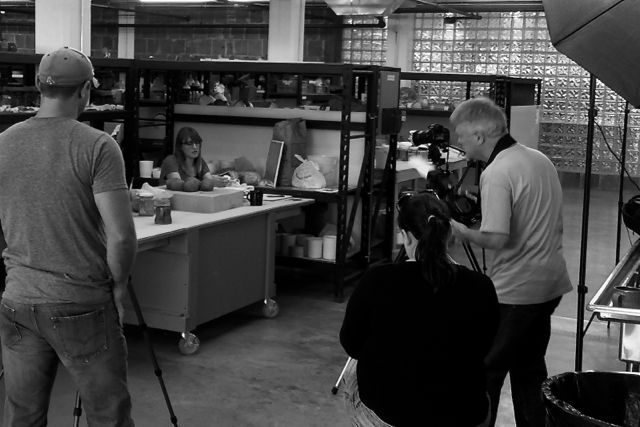
Visiting Jamie Bates Slone at her studio at Red Star Studios in Kansas City, Missouri
All questions can be directed to Frank Juarez, MAS Founder, at midwestartiststudios@gmail.com.
This trip would be not be possible without the support of the Kohler Foundation, Inc, Wisconsin Art Education Association, Sheboygan North High School and Sheboygan Area School District.
 MIDWEST ARTIST STUDIOS ™ PROJECT